
Digital Marketing Trends 2026: Sustainable ROI Strategies
Sustainable ROI in 2026 depends on integrating AI-driven automation with human expertise, exemplified by Minerva Digital Marketing Consultants in Minneola, FL. Founder Margarita “Maggie” Grisales, a Google Ads expert, combines affordable local SEO with precision-targeted campaigns, ensuring businesses achieve measurable, long-term performance growth rather than short-lived traffic spikes.
Sustainable ROI in 2026 demands AI-integrated strategy across the full customer journey, paired with authentic, data-driven execution. At Minerva Digital Marketing Consultants in Minneola, FL, founder Margarita “Maggie” Grisales pairs affordable local SEO with expert Google Ads management to keep performance marketing efficient, human, and growth-focused.
Sustainable ROI in 2026 depends on data-driven performance marketing that ties spend directly to measurable conversions. Minerva Digital Marketing Consultants tracks every click and conversion rather than relying on vanity metrics. Google remains the most widely used platform for local reviews and recommendations, though its share slipped from 83% in 2025 to 71% in 2026 as consumers increasingly turn to generative AI tools for recommendations too, per BrightLocal’s 2026 Local Consumer Review Survey — a shift that means CMOs and business owners need transparent reporting and continuous optimization to scale profitably amid AI-driven search shifts.
Key Takeaways
AI maturity and privacy regulation reshape 2026 search strategies, requiring affordable local SEO expertise.
Marketers scale AI tools while maintaining human connection to build sustainable ROI growth.
Search behavior shifts across platforms demand sharper marketing points of view and adaptation.
Google Ads experts like Maggie Grisales navigate evolving digital landscape for client success.
AI maturity and privacy regulation reshape 2026 search strategies, requiring affordable local SEO expertise.
Marketers scale AI tools while maintaining human connection to build sustainable ROI growth.
Search behavior shifts across platforms demand sharper marketing points of view and adaptation.
Google Ads experts like Maggie Grisales navigate evolving digital landscape for client success.
Why Is 2026 Different for Search Marketing?
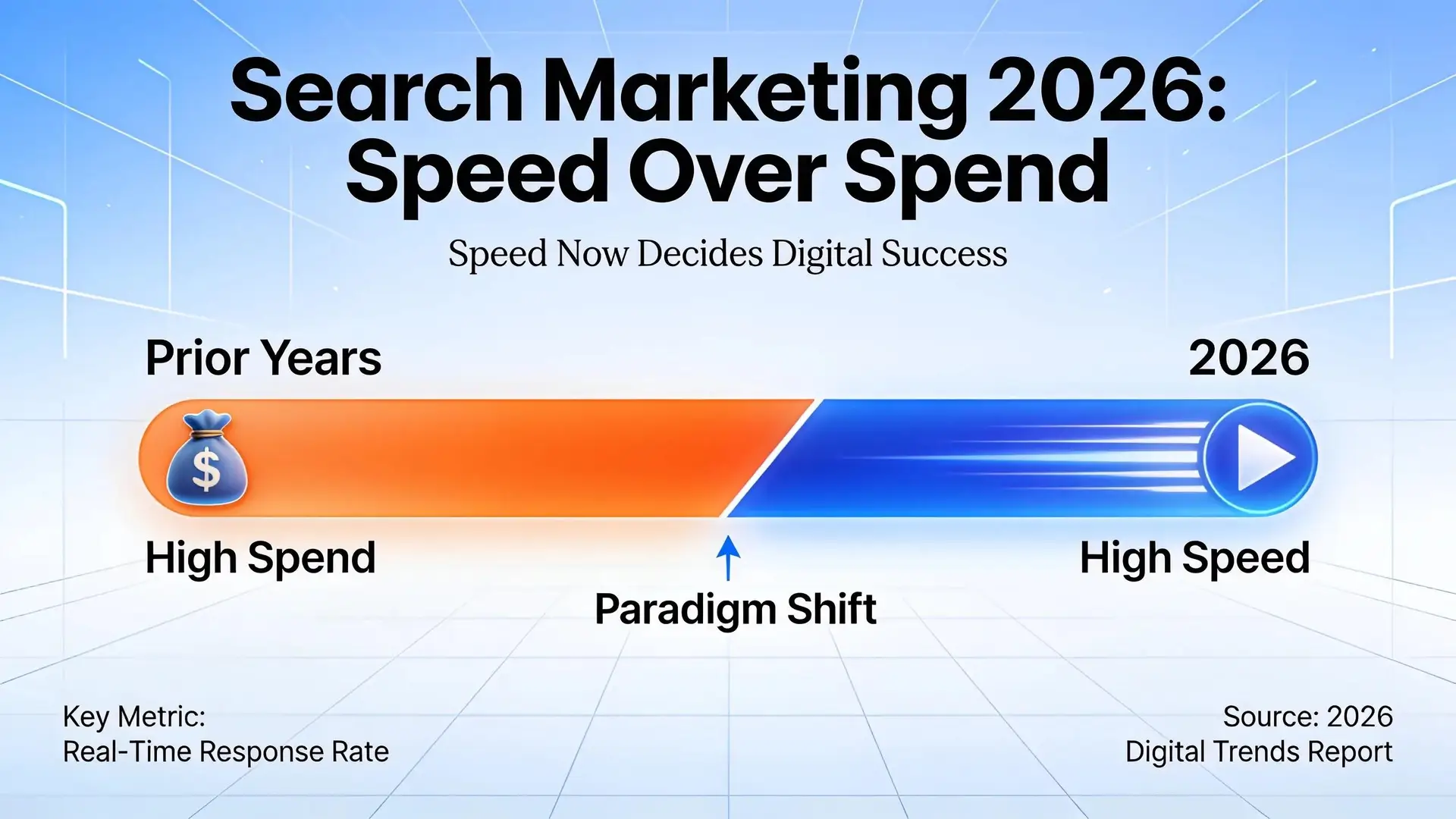
Search marketing in 2026 breaks from prior years because speed, not spend, now decides who ranks and who disappears. Digital marketing is evolving faster than at any point in the past decade, according to IE University’s coverage of 2026 marketing trends, and search algorithms shift alongside that pace. Businesses relying on last year’s playbook find themselves outranked before they even notice the change.
Budget size alone no longer explains rankings. Many businesses invest heavily in marketing yet have no clear proof of what that spend actually delivers. A gap that grows more expensive as competition tightens. Solid, well-run local businesses often lose customers not because service quality slips. Because a competitor simply ranks higher on Google.
Artificial intelligence has also reset the baseline for everyone. The 2026 State of Marketing Report frames the shift directly: the real divide in 2026 isn’t which brands use AI, it’s which brands execute with it skillfully. That distinction is reshaping digital marketing trends 2026 across every industry — adoption is assumed now; mastery is scarce.
What makes search rankings harder to hold onto in 2026?
Rankings move faster because algorithms reward execution quality over raw activity. A business publishing more content without a coherent strategy behind it risks losing position to a leaner, sharper competitor within weeks, not quarters.
Does spending more on ads guarantee better visibility?
Spending more, without measurement, only repeats the same blind-spot problem many businesses already struggle with. Effective search marketing ROI strategies track every dollar against an actual conversion, not clicks or impressions alone.
Three shifts define the difference for 2026:
Execution quality now outweighs tool adoption
Rankings turn over faster than most annual planning cycles account for
Coordinated omnichannel performance marketing separates category leaders from businesses still relying on isolated, disconnected tactics
Execution quality now outweighs tool adoption
Rankings turn over faster than most annual planning cycles account for
Coordinated omnichannel performance marketing separates category leaders from businesses still relying on isolated, disconnected tactics
What's Fueling Digital Marketing Trends in 2026?
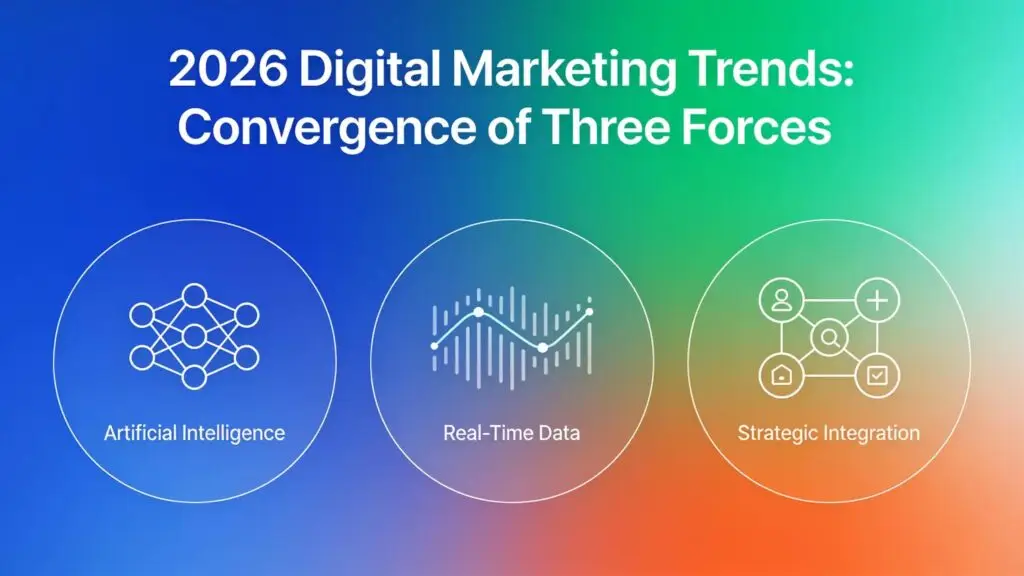
Three forces converge to define digital marketing trends 2026: artificial intelligence, real-time data, and strategy that finally spans the entire customer journey. IE University’s analysis of 2026 marketing points to this convergence as the single biggest shift of the year, replacing channel-by-channel thinking with connected, end-to-end planning. Businesses that keep AI and data siloed inside separate departments fall behind competitors who treat them as one system.
Speed is the second force reshaping expectations. Technology now compresses decision cycles while simultaneously raising what customers expect from every interaction, according to a 2026 marketing trends analysis. Buyers research faster, compare faster, and expect brands to respond just as fast. Marketing Directors who still measure campaign performance monthly instead of in real time lose ground to competitors reacting in days, not weeks.
Why does AI-native decision-making matter for brand growth?
Kantar’s Marketing Trends 2026 outlook names AI-native decision-making among ten trends shaping brand growth this year, alongside topics like purchasing agents and synthetic data. The through-line across all ten: growth increasingly depends on how well a brand embeds AI into decisions, not just execution. Ignoring that shift means competitors make sharper calls with the same budget.
How does local search behavior fit into 2026 planning?
Local visibility remains foundational to any 2026 strategy. BrightLocal’s 2026 Local Consumer Review Survey found that 97% of consumers read online reviews for local businesses, and 41% now say they “always” read reviews when browsing for a business, up from 29% the year before. Google is still the most-used platform for local reviews and recommendations, but usage fell from 83% in 2025 to 71% in 2026, with the majority of that activity happening there. Behavior is also fragmenting: consumers now use an average of six different review platforms, and ChatGPT and other generative AI tools jumped from just 6% to 45% usage for local business recommendations, making AI the third-most-used recommendation source behind Google and Facebook. A business absent from those results loses customers before a single ad or campaign even runs.
Together, these forces demand omnichannel performance marketing built on measurable, connected data — not isolated tactics competing for attention.
How Do You Build Search Marketing ROI Strategies?
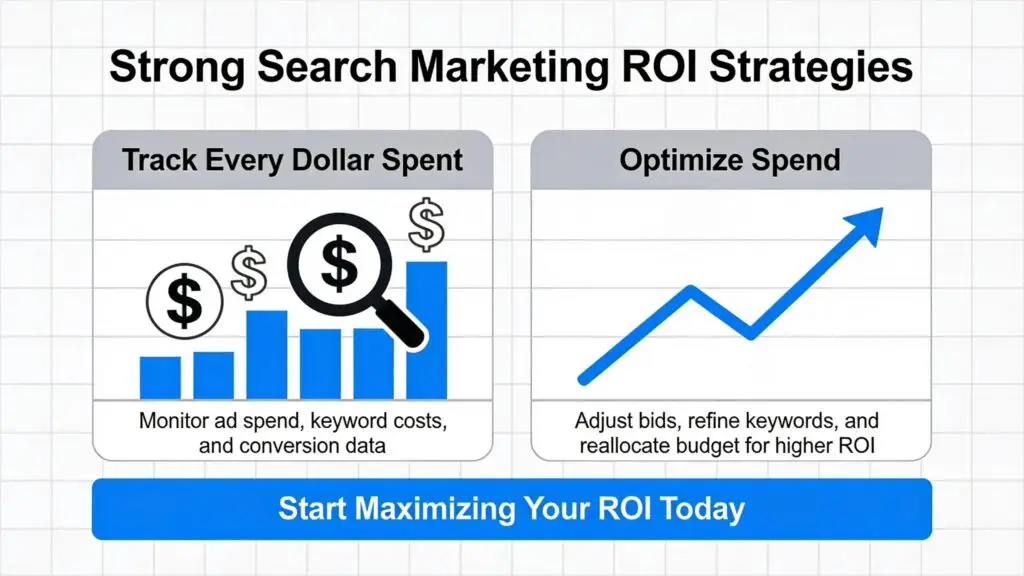
Strong search marketing ROI strategies start with tracking every dollar spent, then optimizing that spend against real outcomes rather than surface-level metrics. Vanity numbers like impressions or clicks tell a limited story. Minerva Digital Marketing Consultants builds campaigns where each dollar gets measured, analyzed, and refined for maximum return, not just reported on.
That distinction matters because ROI-focused advertising flips the payment model. Instead of paying for exposure, businesses pay only for outcomes that actually move the needle: qualified leads, sales, phone calls, or booked appointments. Nothing else counts as success.
Why Do Google Ads Campaigns Fail to Deliver ROI?
Most failed campaigns share one problem: no strategy behind the spend. Running Google Ads without a defined structure drains budgets fast, often before a business sees a single qualified lead. Founder Maggie Grisales brings hands-on Google Ads expertise to every campaign, shaping strategy around measurable outcomes instead of guesswork.
What Makes a Paid Search Campaign Profitable?
Profitability comes from campaigns built specifically for conversions, not clicks. Strategic paid search advertising transforms ad spend into measurable profit through structures designed for sustainable growth over time.
Building a results-driven approach typically involves:
Defining outcomes first — leads, calls, or bookings, not impressions
Tracking every dollar across the full campaign lifecycle
Auditing strategy before scaling budget, so spend never outpaces structure
Optimizing continuously based on measured performance, not assumptions
Defining outcomes first — leads, calls, or bookings, not impressions
Tracking every dollar across the full campaign lifecycle
Auditing strategy before scaling budget, so spend never outpaces structure
Optimizing continuously based on measured performance, not assumptions
Approach | Focus | Payment Trigger |
|---|---|---|
Traditional advertising | Awareness, vanity metrics | Impressions/reach |
Performance-driven paid search | Conversions, profit | Qualified leads, sales, calls, bookings |
Approach
Focus
Payment Trigger
Traditional advertising
Awareness, vanity metrics
Impressions/reach
Performance-driven paid search
Conversions, profit
Qualified leads, sales, calls, bookings
Businesses that skip strategy risk burning budget on activity instead of results. Those that build ROI into the foundation see spend convert into measurable, trackable growth instead of hopeful guesses.
Why Does Omnichannel Performance Marketing Matter Now?
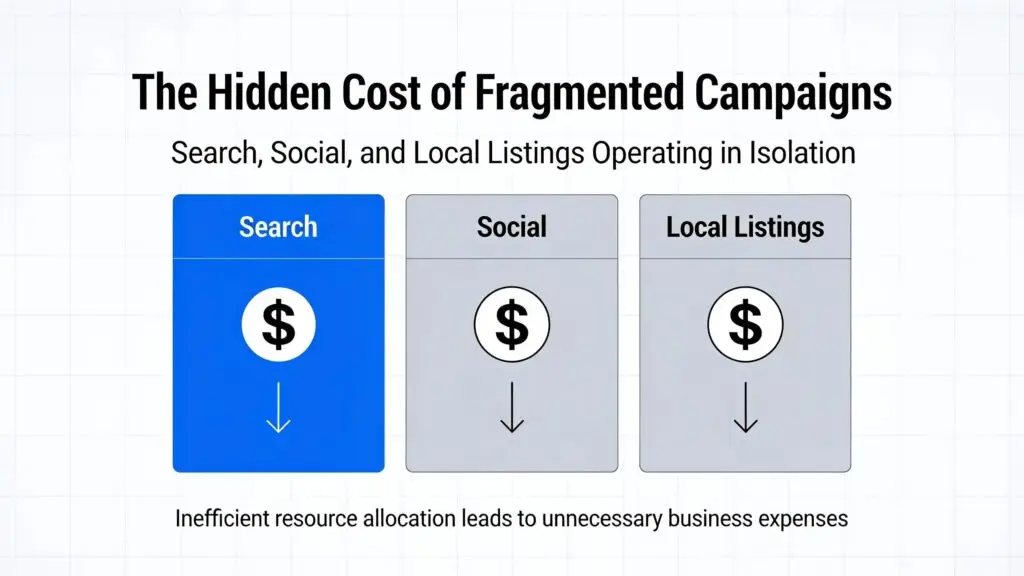
Fragmented campaigns cost businesses real money. When search, social, and local listings operate in isolation, leads fall through the cracks and budgets get wasted. Coordinated, omnichannel performance marketing closes those gaps by treating every channel as part of one measurable system rather than a separate experiment.
Disconnected efforts often look impressive in a slide deck but fail where it counts. Campaigns that appear polished on paper frequently waste thousands of dollars without ever producing a return that can be tracked to a dollar earned. Marketing directors and business owners can’t afford that kind of blind spending in a competitive market.
A structured approach changes the outcome. Minerva Digital Marketing Consultants builds coordinated strategy through the Four Pillars of Page One Domination, a framework that aligns search visibility, advertising, content, and reputation so channels reinforce each other instead of competing for attention. Local businesses, law firms, healthcare providers, and emerging brands all get met at their current stage and grown from there.
How does local SEO fit into an omnichannel strategy?
Affordable local SEO anchors the whole system by keeping a business visible wherever nearby customers search. It feeds consistent, trustworthy signals into paid and organic channels alike, strengthening every other tactic layered on top.
Why do generic marketing templates fail small businesses?
Cookie-cutter templates ignore what makes a business, market, and customer base unique. Data-driven strategies built around specific goals outperform generic playbooks because they adapt to real customer behavior.
That focus matters most for smaller operations. Marketing built for small businesses centers on getting found, getting booked, and sustaining growth. Not vanity metrics that look good but don’t pay the bills.
What Should Marketing Leaders Do Next?
Marketing leaders face a rebuild moment, not a tweak moment. The 2026 State of Marketing Report frames the real divide clearly: the gap isn’t who is using AI. How skillfully teams apply it. Traditional playbooks no longer hold, as shifting consumer behavior and economic pressure force a fresh approach to strategy. Leaders who wait for certainty lose ground to competitors already testing new tactics.
Minerva Digital Marketing Consultants, founded by Maggie Grisales and based in Minneola, FL, partners directly with growth-focused businesses navigating this shift. The firm’s approach centers on digital marketing trends 2026 as a planning input, not a buzzword, translating industry shifts into concrete campaign decisions.
How should leaders prioritize spend right now?
Budget decisions should follow measurable performance, not channel preference. Prioritizing search marketing ROI strategies means tracking cost per lead, conversion rate, and revenue attribution before scaling any campaign. All-in-one Google Ads management, structured around clear performance benchmarks, helps businesses dominate their market segment while keeping advertising spend accountable to results.
What does an integrated strategy look like in practice?
Integration means every channel reinforces the others instead of competing for the same budget line. An omnichannel performance marketing model connects search, social, and paid media so leads move smoothly from first click to closed deal.
Practical next steps for leadership teams:
Audit current campaigns against actual ROI, not impressions or reach
Rebuild strategy assumptions around 2026 consumer behavior shifts
Apply AI tools with clear measurement standards, not adoption for its own sake
Align Google Ads management with broader omnichannel goals
Audit current campaigns against actual ROI, not impressions or reach
Rebuild strategy assumptions around 2026 consumer behavior shifts
Apply AI tools with clear measurement standards, not adoption for its own sake
Align Google Ads management with broader omnichannel goals
Leaders who act on these steps position their teams ahead of competitors still relying on outdated assumptions.
FAQ
Why is 2026 different for search marketing?
Speed, not spend, now decides who ranks. Algorithms shift quickly, and businesses relying on last year’s playbook find themselves outranked before they notice the change, making continuous optimization essential for sustainable ROI.
No, spending more without measurement only repeats existing blind spots. Effective search marketing ROI strategies track every dollar against actual conversions, not just clicks or impressions, ensuring transparent, data-driven performance.
How does Minerva Digital Marketing Consultants help businesses achieve sustainable ROI?
Founder Margarita “Maggie” Grisales, a Google Ads expert, pairs affordable local SEO with expert ad management from Minneola, FL, tracking every click and conversion to keep performance marketing efficient and growth-focused.
Conclusion
In closing, the future of search and performance marketing demands a strategic shift toward sustainable, data-driven approaches that prioritize genuine ROI over vanity metrics. Businesses that embrace these 2026 trends—integrating advanced analytics, authentic engagement, and localized strategies—position themselves to thrive in an increasingly competitive digital landscape. The path forward belongs to those willing to invest in transparent partnerships. Measurable results, transforming marketing from a cost center into a genuine growth engine that delivers lasting competitive advantage.
